Unable to load SSI head
←Part 6 PMD Part 8 Cable→
Network Data Flow Example for a 4-UTP 100VG-AnyLAN Network
For this example, the node will send one normal-priority packet on the
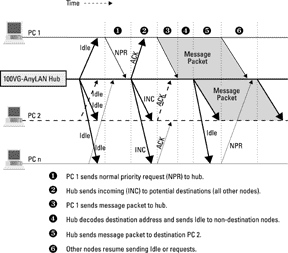
network. Figure 9 illustrates the sequence of events.
Figure 9
The data flow in a 100VG-AnyLAN network begins when the upper layer software
(logical link control sublayer) of the end node advises the media access
sublayer that it has a packet to send on the network. After receiving the
packet, the media access control sublayer adds the source address and any
required pad bits to complete the data field.
The source node sends a normal priority request (NPR); tone 1 on channel 2
and tone 2 on channel 3, to the hub requesting to send a normal priority
packet on the network. (See figure 9, time segment 1.)
During its round-robin scan procedure, the hub selects the source node and
stops sending control tones (Idle) on channel 0 and channel 1 of the source
node port-clearing the link to allow the node to transmit the packet on all
four channels.
The hub then alerts all potential destination nodes on the network segment
that a packet may be destined for them by sending an Incoming (INC) message;
tone 1 on channel 0 and tone 2 on Channel 1. (See figure 9, time segment 2.)
The potential destination nodes stop sending control tones on channel 2 and
channel 3-clearing the link to allow the node to receive the packet on all
four channels.
Meanwhile, the source node detects that the link is clear and forwards the
message packet from the media access control sublayer to the physical medium
independent sublayer to prepare the data for transmission.
The physical medium independent sublayer separates the data into four
channels, scrambles the five-bit data quintets, and encodes the quintets
into six-bit (5B6B) symbols. The preamble, start frame delimiter, and end
frame delimiter are added to each channel.
The physical medium dependent sublayer begins to send the packet to the hub
using NRZ encoding. (See figure 9, time segment 3.)
As the hub receives the packet, it decodes the destination address. (See
figure 9, time segment 4.)
The packet is then routed to the node(s) with the matching destination
address(es). (See figure 9, time segment 5.) At the same time, the hub stops
sending INC and begins to send Idle; tone 1 on channel 0 and channel 1, to
the other nodes. All other nodes then resume sending requests, or idle, to
the hub. (See figure 9, time segment 6.)
←Part 6 PMD Part 8 Cable→
Unable to load SSI foot