Unable to load SSI head
←Part 5 PMI Part 7 Flow→
Physical Medium Dependent (PMD) Sublayer Functions
The physical medium dependent sublayer functions include channel
multiplexing (for the 2-pair and fiber-optic implementations only), NRZ
encoding, link medium operation, and link-status control.
As previously mentioned, the 100VG-AnyLAN technology will support four types
of cabling media:
* 4-pair Unshielded Twisted-Pair
* 2-pair Unshielded Twisted-Pair
* 2-pair Shielded Twisted-Pair
* Single or Multimode Optical Fiber
Because the details of the 2-pair and fiber-optic cabling are still under
development, this section will describe only the details of the 4-pair
unshielded twisted-pair cabling.
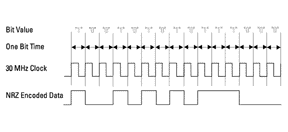
NRZ Encoding, illustrated in figure 7, is a two-level, non-return-to-zero
(NRZ) signaling mechanism used to transmit data and link-status control
signals onto the network medium.
Figure 7
Using NRZ encoding, one bit of data is transmitted per clock cycle. A bit
value of 1 is detected when a high voltage signal is transmitted, and a bit
value of 0 is detected when a low voltage level signal is transmitted.
A 100VG-AnyLAN network using 4-pair unshielded twisted-pair cabling uses a
30-MHz clock to transmit 30 Mbits of data on each of the four pairs, which
results in an encoded data rate of 120 Mbits per second. At the receiving
end, the 30 Mbits of encoded data are received and decoded into 25 Mbits of
the original data, resulting in an effective data rate of 100 Mbits per
second (4 pair x 25 Mbits per second per pair).
In addition to providing an efficient method for data transmission, NRZ
encoding allows 100VG-AnyLAN to operate on voice-grade, category 3 UTP
cable. Using a 30-MHz clock, NRZ encoding generates a maximum transmission
frequency of 15 MHz on the cabling medium. (A transmission frequency of 15
MHz is derived from considering a worst-case data pattern of 10101010, etc.
Before filtering, this data pattern would produce a 15-MHz square wave. In
addition to meeting the specifications required for category 3 cable
support, this low frequency also reduces radio frequency interference and
electromagnetic emissions to meet U.S. FCC and international CISPR
regulations.
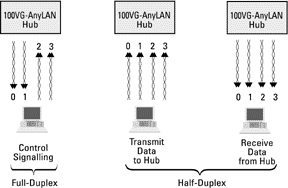
Link Medium Operation for a 4-UTP 100VG-AnyLAN network uses both a
full-duplex and a half-duplex mode of operation, as illustrated in figure 8.
Figure 8
Full-duplex operation is required to communicate link-status control
information between the hub and the node. A 4-UTP 100VG-AnyLAN network
requires four twisted pairs for operation and uses the same 1/2, 3/6, 4/5,
and 7/8 pair configurations as Ethernet and token ring, and as specified by
the EIA/TIA 568 wiring standard. Link-status control from the hub to the
node uses wires 1 and 2 (channel 0), and wires 3 and 6 (channel 1).
Link-status control from the node to the hub uses wires 4 and 5 (channel 2)
and wire 7 and 8 (channel 3).
Half-duplex operation uses all four channels to transmit data from the node
to the hub or receive data from the hub to the node.
Link-Status Control operates in a full-duplex mode, and uses a combination
of two low-frequency tones-refered to as Tone 1 and Tone 2-to communicate
status between the hub and the node.
Tone 1 is generated by transmitting a 30-MHz alternating pattern of sixteen
1's followed by sixteen 0's etc., producing a transmission frequency of
approximately 0.9375 MHz.
Tone 2 is generated by transmitting a 30-MHz alternating pattern of eight
1's followed by eight 0's etc., producing a transmission frequency of
approximately 1.875 MHz.
100VG-AnyLAN communicates status commands between the hub and the node using
a combination of these two low-frequency tones. Table 1 lists the
definitions for the tone combinations transmitted by the hub and the node.
Table 1. Definitions
| Tone Pattern Transmitted |
Meaning Received by the Node |
Meaning Received by the Hub |
|---|
| 1-1 | Idle | Idle |
| 1-2 | Incoming Data Packet | Normal Priority Request |
| 2-1 | Reserved | High Priority Request |
| 2-2 | Link Training Request | Link Training Request |
Idle indicates to the node that the hub has no pending packets and indicates
to the hub that no requests are pending.
Incoming indicates to the node that a packet may be destined for that port.
The node is instructed to stop sending control tones on channel 2 and 3 in
preparation to receive the packet.
Normal Priority Request indicates to the hub that the node is requesting to
send a normal priority packet.
High Priority Request indicates to the hub that the node is requesting to
send a high priority packet.
Link Training Request indicates to the node or to the hub that link
initialization is being requested.
←Part 5 PMI Part 7 Flow→
Unable to load SSI foot