Unable to load SSI head
←Part 1 Intro Part 3 Tech→
100VG-AnyLAN Network Structure
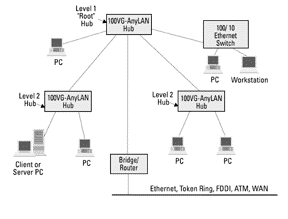
A 100VG-AnyLAN network, illustrated in figure 1, consists of a central hub
or repeater, referred to as a level 1 (or root) hub, with a link connecting
each node-creating a star topology.
Figure 1
The Hub is an intelligent central controller that manages the network access
by continually performing a rapid "round robin" scan of its network port
requests, checking for service requests from the attached nodes. The hub
receives the incoming data packet and directs it only to the port with a
matching destination address(es) providing inherent network data security.
Each hub may be configurable to support either 802.3 Ethernet or 802.5 token
ring frame formats. All hubs located in the same network segment must be
configured for the same frame format. A bridge may be used to connect a
100VG-AnyLAN network using an 802.3 frame type to an Ethernet network, or a
100VG-AnyLAN network using an 802.5 frame type to a token ring network. A
router may be used to connect a 100VG-AnyLAN network to FDDI and ATM
networks or to WAN connections.
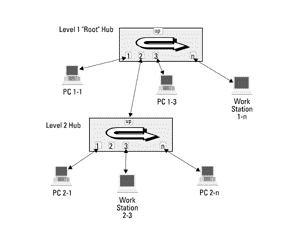
Each hub includes one up-link port and "n" number of down-link ports, as
shown in figure 3. The up-link port functions as a node port but is reserved
for connecting the hub (as a node) to an upper level hub. The "n" down-link
ports are used to connect to 100VG-AnyLAN nodes.
Figure 3
Each hub port may be configured to operate in either a normal mode or a
monitor mode. Ports configured to operate in normal mode are forwarded only
those packets intended (addressed) for the attached node. Ports configured
to operate in a monitor mode are forwarded all packets that the hub
receives. The normal and monitor mode configuration may be automatically
learned for cascaded ports (an up-link or down-link to another hub) or
manually configured for a port connected to network monitoring equipment.
A Node may be a client or server computer, workstation, or other
100VG-AnyLAN network device such as a bridge, router, switch, or hub. Hubs
connected as nodes are referred to as lower level-such as level 2, or level
3 hub devices. (Up to three levels of cascading may be used on a
100VG-AnyLAN network.)
A node issues requests to the hub to initiate link training (see the "Link
Warning" section later in this paper) and to send a packet onto the network.
The 100VG-AnyLAN node also responds to incoming message commands from the hub.
The Link connecting the hub and the node may be 4-pair UTP cable (Category
3, 4, or 5), 2-pair UTP cable (Category 5), 2-pair STP cable, or fiber-optic
cable. The maximum length of the cable from the hub to each node is 100
meters for Category-y 3 and 4 UTP, 150 meters for Category 5 UTP and STP,
and 2000 meters for fiber optic cable. The UTP and STP cable must be wired
straight through (pin 1 connects to pin 1, pin 2 connects to pin 2, etc.)
for all node connections.
Although any of the three above cabling types may be used, this paper will
focus primarily on the 4-pair unshielded twisted-pair medium application,
referred to as a 4-UTP 100VG-AnyLAN network.
←Part 1 Intro Part 3 Tech→
Unable to load SSI foot