Unable to load SSI head
←Part 3 Tech Part 5 PMI→
The Media Access Control (MAC) Sublayer Functions
The 100VG-AnyLAN media access control functions include demand priority
protocol control, link training, and MAC frame preparation.
Demand Priority is a network access method in which nodes issue a request
(or demand) to the hub to send a packet on the network. Each request is
labeled with either a normal-priority level-for normal data packets, or a
high-priority level-for packets supporting time-critical multimedia
applications. High-priority requests are granted access to the network
before normal-priority requests, providing a method to guarantee appropriate
service for time-sensitive applications. Normal-priority and high-priority
labeling is completed by upper-level application software, and is passed (as
part of the packet information) to the MAC sublayer.
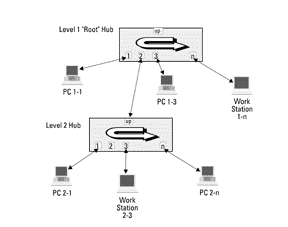
As illustrated in figure 3, the level 1 or root hub continuously scans node
requests, using a round-robin arbitration procedure. The round-robin
scanning allows the hub to determine which nodes, if any, are requesting to
send a packet, and whether the request is for normal-priority or
high-priority packets.
Figure 3
Each round-robin scanning cycle allows each node to request to send one
packet on the network. Hubs connected as nodes also complete a round-robin
scanning cycle, and issue a request to the root hub. Single- port nodes may
only send one packet (if other nodes have pending requests). A lower-level
hub with "n" nodes connected will be able to send "n" packets when it is
selected during the round-robin process (if no other high-priority requests
are pending).
Each hub maintains a separate list for normal-priority and High-priority
requests. Normal-priority requests are serviced in port order until a
high-priority request is received. After completing the packet transmission
currently in progress, the hub will service the high-priority request. All
high-priority packets will be serviced before the hub returns to service the
normal-priority list. To guarantee access for normal- priority requests
during an excess of high-priority traffic, the hub continually monitors node
request-to-send response times. If the delay exceeds an established maximum
time, the hub will automatically raise the normal-priority level to a
high-priority level.
Figure 3 will be used to show an example of the hub round-robin scanning
cycle. First, consider that all ports have normal-priority requests pending,
and that the round-robin sequence is at the root or level 1 hub, port 1, at
time t=O. The packet service order would be 1-1 (level 1 hub - port 1), 2-1
(level 2 hub - port 1), 2-3, 2-n, 1-3, and 1-n. If node 1-1, 2-3, and 1-3
issued a high-priority request at time t=O, the packet service order would
be 1-1, 2-3, 1-3, 2-1, 2-n, and 1-n.
Link Training is a link initialization procedure that optimizes or "trains"
the internal hub and node circuitry for data reception and transmission, and
verifies the operation of the link connecting the hub and the node.
During link training, the hub and the node exchange a series of special test
packets. This procedure provides a functional test of the cable to verify
that the cable is correctly wired and that data may be successfully
transferred to and from the hub and the node.
Link training also allows the hub to automatically learn information about
the node device connected to each port. Packets received by the hub from the
training node contain information such as the device type (hub, bridge,
router, network test/monitor equipment, etc.), operational mode (normal or
monitor), and the station address of the device attached to that port.
Link training is initiated by the node when the hub and node are first
powered on, or when the node is first connected to the hub. The node or hub
may also request link-training when certain error conditions are detected.
MAC Frame Preparation is completed after receiving the packet from the
Logical Link Control sublayer. The MAC sublayer adds the node source
address, and any required bits to complete (or pad) the data field. A Frame
Check Sequence (FCS) is then calculated and appended to the end of the
packet. (The FCS will be used by the receiving hub and node to determine if
the packet has been received without errors.)
←Part 3 Tech Part 5 PMI→
Unable to load SSI foot